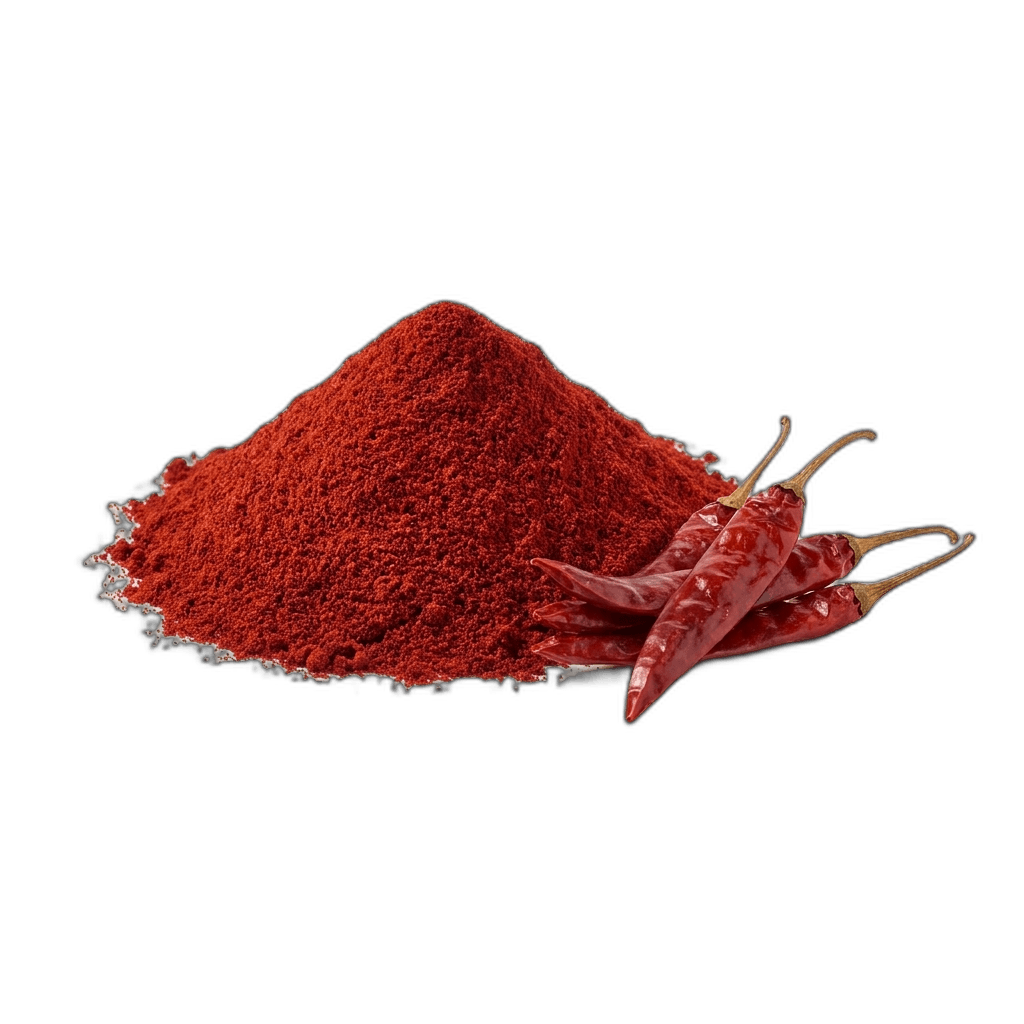
Kashmiri Chilli Powder
Lal Mirch Powder
Milled from sun-dried Byadgi chillies grown across the red-soil belt of Haveri district in Karnataka, this is a colour chilli first and a heat chilli second. It lends a glowing crimson hue and a soft, fruity warmth rather than searing heat, making it the powder of choice for biryani, tandoori marinades and rich gravies where colour matters as much as fire. A pinch transforms the look of a dish without overwhelming the palate.
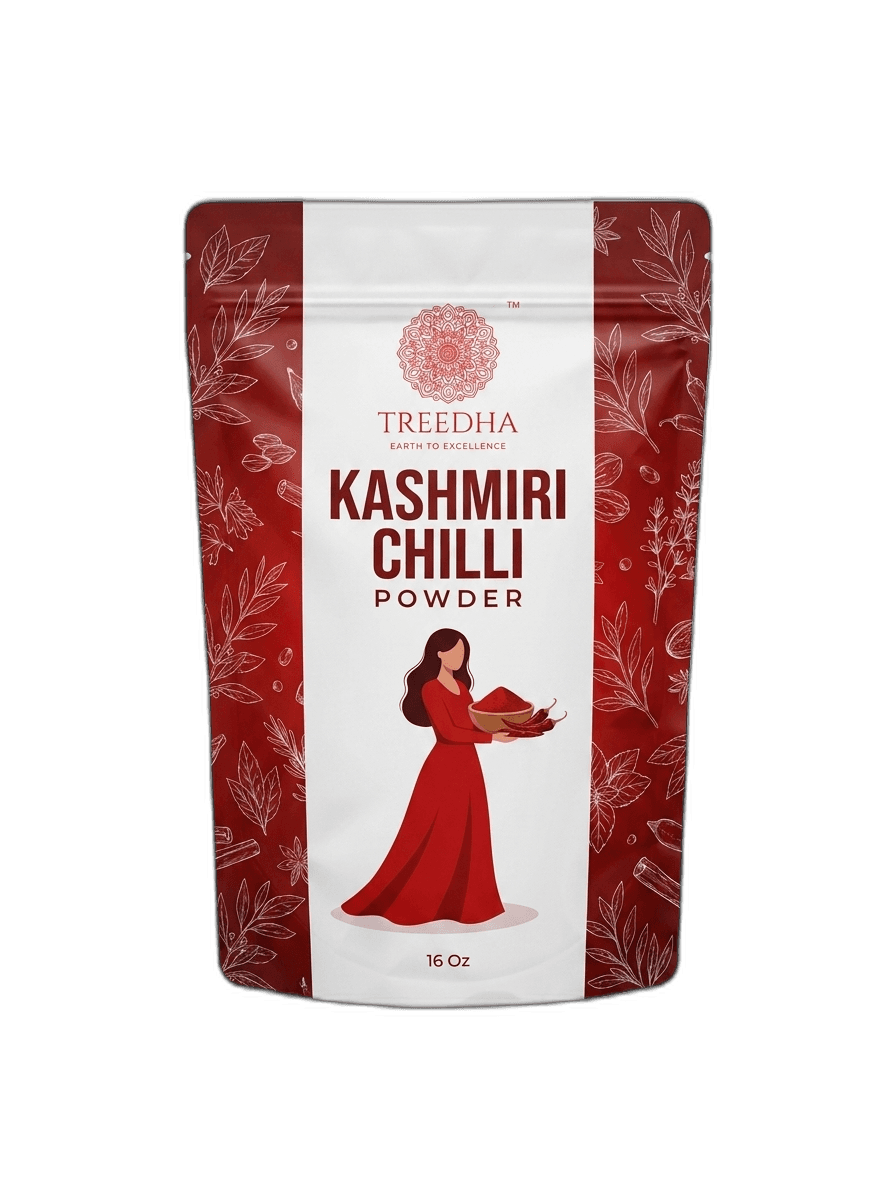
Sealed at peak, shipped with provenance.
Packed in resealable, food-grade pouches that lock in aroma and colour — each labelled with its origin, grade and taste profile.
- Byadgi belt, Karnataka, India
- Byadgi Dabbi · high-colour (~150 ASTA)
- Finely milled powder
- Mild · approx. 8,000-15,000 SHU
- Steam-sterilised · ETO-free · lab-tested
- 12-18 months, stored cool and sealed
Also known as · Lal mirchi powder · Kashmiri red chilli powder · Piment rouge moulu · Capsicum annuum
How to use it
Tandoori and tikka marinades for a natural red glow
Biryani, pulao and rich tomato gravies
Pickles and chutneys where colour is paramount
Spice blends and masalas needing depth without heat
Kashmiri Chilli Powder (Lal Mirch Powder) is a mild, high-colour chilli prized for its vibrant red hue and subtle heat. Sourced from India's Byadgi belt, it is a key ingredient for food manufacturers and private-label brands seeking authentic flavour and natural colouring.
Sourcing & Origin
Treedha's Kashmiri Chilli Powder (Lal Mirch Powder) originates specifically from the Byadgi belt within Karnataka, India, at an elevation of 550-650 metres. This region is renowned for cultivating the Byadgi Dabbi variety, celebrated for its exceptional colour without overwhelming pungency. The unique agro-climatic conditions contribute to the chilli's distinctive characteristics, making it highly sought after in the global bulk trade.
The chillies are sun-dried whole at origin, then meticulously de-stemmed before being finely milled. This careful processing at source ensures the preservation of the chilli's vibrant red pigment, measured at approximately 150 ASTA, a crucial specification for bulk buyers focused on consistent product quality and natural food colouring applications.
Export Grades & Specifications
Our Kashmiri Chilli Powder is supplied as Byadgi Dabbi, a high-colour grade known for its vivid red hue and mild heat profile. Key specifications for this finely milled powder include a colour value of approximately 150 ASTA, indicating its strong pigmentation, and a mild pungency ranging from 8,000 to 15,000 SHU. These parameters are critical for importers requiring precise product characteristics for their food manufacturing and private-label needs.
Rigorous quality controls ensure a moisture content of below 10-12%, vital for extended shelf life and preventing microbial growth. The powder is typically supplied at a fine granulation, around 80 mesh, ensuring uniform dispersion in various food applications. Treedha provides a comprehensive Certificate of Analysis (COA) for each batch, detailing these physical, chemical, and microbiological parameters to assure buyers of consistent quality.
| Parameter | Specification for Byadgi Dabbi Grade |
|---|---|
| Colour Value (ASTA) | ~150 ASTA |
| Heat Level (SHU) | Mild · 8,000-15,000 SHU |
| Moisture Content | ≤ 10-12% |
| Purity | 100% Pure, ETO-free |
| Granulation | Finely milled, ~80 mesh |
| Total Ash | Max 8% |
| Acid Insoluble Ash | Max 1.3% |
| Foreign Matter | Max 0.5% |
Quality, Safety & Compliance
Treedha's Kashmiri Chilli Powder (Lal Mirch Powder) adheres to stringent international food safety and compliance standards for bulk export. Our product is steam-sterilised, guaranteeing it is ethylene-oxide-free (ETO-free), a critical requirement for markets such as the European Union (EU) and the United States (US). This processing method effectively reduces microbial load while preserving the chilli's natural qualities.
All batches are lab-tested by accredited third-party laboratories to meet strict limits for aflatoxins (typically 5 PPB for Aflatoxin B1 and 10 PPB for Total Aflatoxin), pesticide residues (MRLs), and the absence of Salmonella (Absent in 25g). Furthermore, testing confirms the absence of illegal Sudan dyes and heavy metals. Comprehensive documentation, including Phytosanitary Certificates, Certificates of Origin, and detailed Certificates of Analysis (COA), accompanies every shipment to ensure full transparency and compliance with destination country regulations like those of the FDA and EU.
Global Demand & Target Markets
Demand for high-colour, mild chilli powder like Kashmiri Chilli Powder (Piment rouge moulu) is robust across key international markets. Major importing regions include the USA, European countries (such as the UK and Germany), the UAE and Gulf Region, Southeast Asia (Malaysia, Indonesia, Singapore, Thailand), and Australia. This sustained demand is driven by the global expansion of ethnic cuisines, particularly Indian, Mexican, and Thai, which rely on authentic spice ingredients for flavour and visual appeal.
Increasing urbanisation and evolving dietary habits contribute to greater consumption of packaged foods, ready meals, and snack seasonings, where Kashmiri chilli powder serves as both a flavour enhancer and a natural colouring agent. The clean-label trend and demand for single-origin, traceable products further bolster the appeal of our Byadgi Dabbi chilli, which is also valued for its role in oleoresin extraction for food and cosmetic industries.
Logistics, HS Code & Packing
For international trade, Kashmiri Chilli Powder (Capsicum annuum) is classified under Harmonised System (HS) code 0904.22.11, specifically for crushed or ground fruits of the genus Capsicum. Treedha offers flexible bulk packing solutions designed for the efficiency and safety required by importers and distributors. Our standard bulk options include robust multi-wall paper bags with inner food-grade liners, ensuring product integrity during transit and storage. While we offer typical pack sizes from 100g to 500g for private-label clients, we primarily deal in larger bulk quantities suitable for wholesale distribution.
Minimum Order Quantity (MOQ) is discussed on a case-by-case basis, tailored to meet specific buyer requirements and logistical feasibility, typically involving full container loads for optimal shipping economy. We facilitate shipments on standard Incoterms such as FOB (Free On Board) and CIF (Cost, Insurance and Freight) from major Indian ports. With optimal storage conditions—cool, dry, and sealed—our Kashmiri Chilli Powder maintains its quality and flavour for a shelf life of 12-18 months.
- herbnseed.com — herbnseed.com
- clearcust.com — clearcust.com
- kapadiyaexpocompany.com — kapadiyaexpocompany.com
- reddit.com — reddit.com
- volza.com — volza.com
- zestnzingfoods.com — zestnzingfoods.com
Questions
- Is lal mirch powder the same as chilli/cayenne powder?
- They are close cousins. Lal mirch simply means red chilli in Hindi, and our powder is milled from Byadgi chillies prized for deep colour and mild heat. Standard cayenne is far hotter and lower in colour, so use this where you want a vivid red finish rather than aggressive fire.
- How hot is this powder?
- Gently warm. Byadgi chilli is naturally low in capsaicin, landing around 8,000-15,000 SHU, so it builds colour and a fruity warmth without the sharp burn of Guntur or Teja chilli.
- Why is it so deeply red?
- Byadgi chillies carry one of the highest natural colour values of any Indian chilli, roughly 150 ASTA. That pigment is what gives tandoori dishes and gravies their signature glow.
- What is the primary difference between Kashmiri Chilli Powder and other red chilli powders?
- Kashmiri Chilli Powder (Lal Mirch Powder), particularly the Byadgi Dabbi variety, is primarily known for its vibrant red colour (high ASTA value of ~150) and mild heat (8,000-15,000 SHU), whereas many other chilli powders focus more on high pungency.
- Is Treedha's Kashmiri Chilli Powder (Lal Mirchi Powder) ETO-free and lab-tested?
- Yes, our Kashmiri Chilli Powder is steam-sterilised, making it ETO-free. It is rigorously lab-tested by accredited third-party laboratories for aflatoxins, pesticide residues, heavy metals, and microbiological parameters to meet strict EU and US import limits.
- What is the ASTA value of your Kashmiri red chilli powder?
- Our Byadgi Dabbi Kashmiri red chilli powder is specifically graded for high colour, with an approximate ASTA (American Spice Trade Association) value of 150. This indicates a rich, stable red pigment, ideal for natural food colouring applications.
- What are the common HS Codes for importing Kashmiri Chilli Powder from India?
- The primary Harmonised System (HS) codes for crushed or ground red chilli, including Kashmiri Chilli Powder, are 0904.22, 0904.22.11, and 0904.22.19, depending on the specific classification required by the importing country.
- Can Treedha supply Kashmiri Chilli Powder (Piment rouge moulu) for private-label packaging?
- Yes, Treedha specialises in supplying bulk, high-quality Kashmiri Chilli Powder for private-label requirements. We work with importers and distributors to meet their specific branding and packaging needs, ensuring compliance with international standards.
- What is the shelf life of Treedha's Kashmiri Chilli Powder?
- When stored under optimal conditions—cool, dry, and sealed—our finely milled Kashmiri Chilli Powder (Lal Mirch Powder) has a shelf life of 12-18 months, retaining its quality, colour, and mild flavour.