Cracked Wheat
Dalia / Lapsi
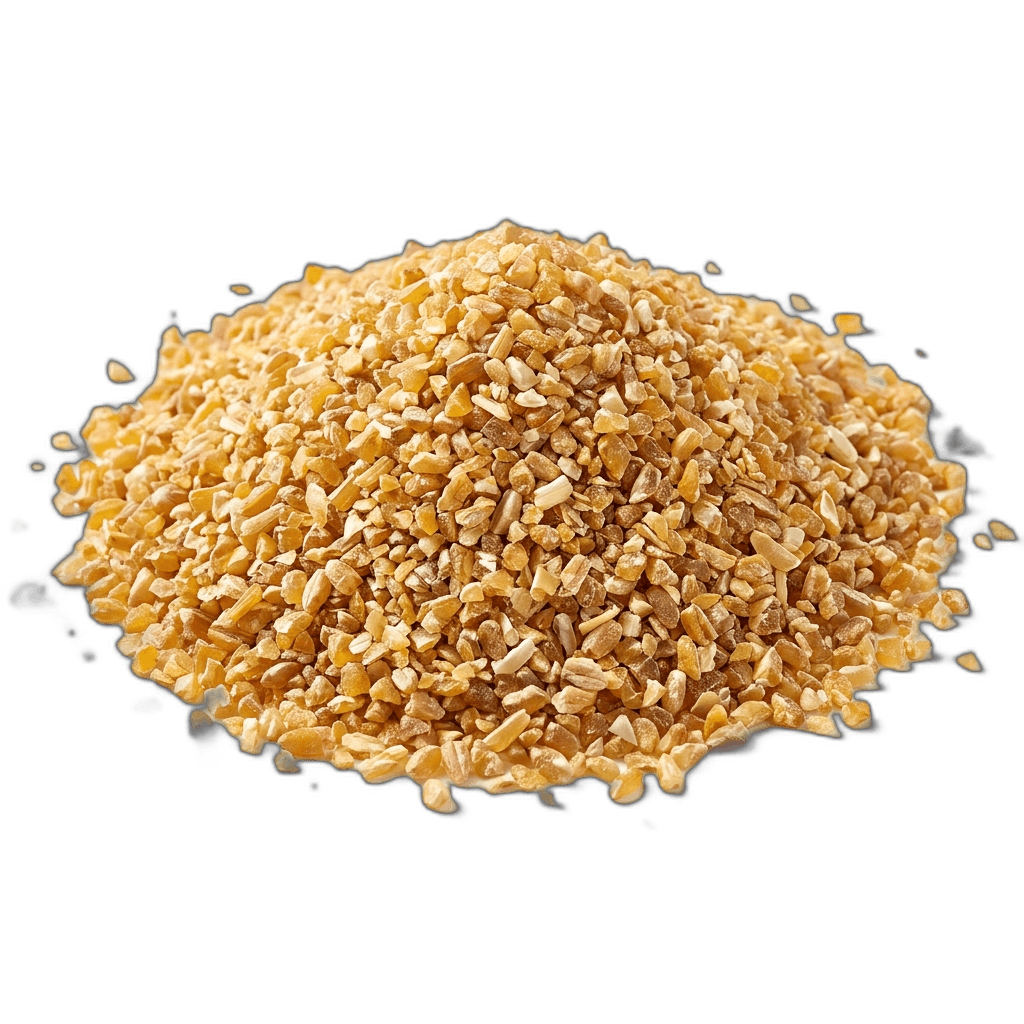
Malet af hård hvede dyrket på tværs af det centrale Indiens Malwa-plateau er vores knækkede hvede forkogt, tørret og brækket til en ren, jævn gryn. Forkogningen låser klid og kim inde, mens den halverer kogetiden, hvilket giver et nøddeagtigt, svagt sødt korn med et tilfredsstillende tyggemodstand. Damp den til en salt upma, simre den med jaggery og ghee til lapsi, eller vend den kold i en urtefrisk tabbouleh.
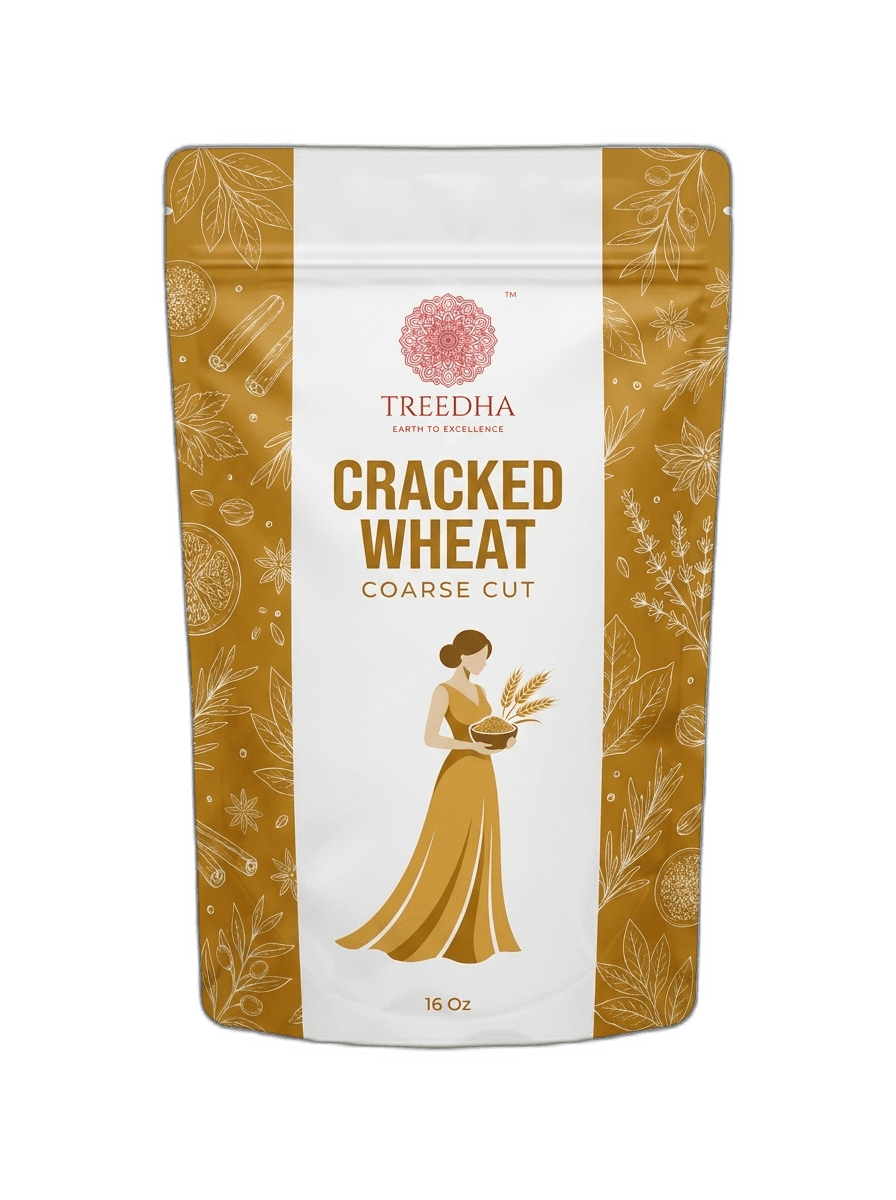
Forseglet på toppen, sendt med proveniens.
Pakket i genlukkelige fødevaregodkendte poser, der bevarer aroma og farve — hver mærket med oprindelse, kvalitet og smagsprofil.
- Indien
- Malwa-plateauet, Madhya Pradesh
- Grov #3 snit
- Forkogt · ovntørret · knækket
- Fuldkorn · sortex-renset · ingen tilsætningsstoffer
- 12-18 måneder ved stuetemperatur, forseglet
Også kendt som · Bulgur · Fada · Burghul · Tabbouleh Wheat
Sådan bruger du det
Dampet til upma med tempererede krydderier og grøntsager
Simret med jaggery, ghee og kardemomme til lapsi
Iblødsat koldt til tabbouleh og kornsalater
Foldet ind i kibbeh og fyld til fyldte grøntsager
Kogt til en salt eller sød morgenmadsgrød
Cracked Wheat (Dalia / Lapsi) is a versatile, parboiled whole grain sourced from India's Malwa Plateau. Valued for its nutritional profile and quick-cooking nature, it serves as a culinary staple in various global cuisines, offered by Treedha to bulk importers and private-label buyers worldwide.
Sourcing & Origin
Treedha's Cracked Wheat, also known as Dalia or Lapsi in India, and globally as Bulgur, Fada, Burghul, or Tabbouleh Wheat, originates from the fertile Malwa Plateau in Madhya Pradesh, India. Situated at an elevation of 450-550 metres, this region is renowned for producing high-quality durum wheat, which is ideal for parboiling and cracking.
The distinct terroir of the Malwa Plateau, combined with optimal climatic conditions, contributes to the superior characteristics of the wheat. For bulk buyers, sourcing from this specific Indian origin ensures a consistent supply of grain with desirable texture and nutritional integrity, critical for culinary applications from traditional South Asian dishes to Mediterranean tabbouleh.
Export Grades & Specifications
Treedha specialises in Coarse #3 cut, parboiled Cracked Wheat, a grade distinguished by its particle size and convenient preparation. This specific cut typically exhibits a granulation of 1.5–2.2 mm, offering a hearty texture suitable for a wide array of recipes.
Our Cracked Wheat undergoes a meticulous process: it is cleaned, parboiled, kiln-dried, and then precisely cracked. Further sortex-cleaning ensures uniform grit and exceptional purity, free from foreign matter. The parboiling step gelatinises the starch, making the grain quicker to cook and more resistant to pests, enhancing its appeal for bulk trade.
| Specification | Coarse #3 Cut (Treedha) | Fine #1 Cut (Typical) | Medium #2 Cut (Typical) |
|---|---|---|---|
| Particle Size | 1.5–2.2 mm | <1 mm | 1–1.5 mm |
| Process | Parboiled, kiln-dried | Raw or Parboiled | Raw or Parboiled |
| Moisture Content | ≤ 12% | ≤ 12% | ≤ 12% |
| Protein Content | 11-14% | 11-14% | 11-14% |
| Purity | Whole grain, sortex-cleaned | Good | Good |
| Whole Grains | ≤ 2% | ≤ 2% | ≤ 2% |
Quality, Safety & Compliance
Treedha adheres to rigorous international food safety standards, ensuring our Cracked Wheat (Dalia / Lapsi) meets the stringent requirements of global markets like the EU and US. Our product is steam-sterilised, confirming it is ethylene-oxide-free (ETO-free), a critical compliance point for EU imports where ETO is banned and subject to MRLs of 0.1 mg/kg (sum of ETO and 2-chloro-ethanol, expressed as ETO), as per EU regulations.
Each batch is lab-tested for contaminants, including aflatoxins and mycotoxins. For EU markets, our products meet limits such as 2.0 µg/kg for Aflatoxin B1 and 4.0 µg/kg for total Aflatoxins (B1+B2+G1+G2) in cereals, as set by the European Commission. We also ensure compliance with pesticide MRLs (default EU MRL of 0.01 mg/kg if no specific level exists) and strict microbiological criteria, including Salmonella (0 cfu/25g), a common specified maximum for coarse bulgur. Heavy metals such as arsenic, cadmium, and lead are also monitored per Regulation (EU) 2023/915 and FDA guidance.
Comprehensive documentation accompanies every shipment, including a Phytosanitary Certificate and a detailed Certificate of Analysis (COA). This COA verifies quality parameters like moisture content, protein levels, and screening results for ETO, aflatoxins, MRLs, and Salmonella, providing full provenance and transparency for our bulk buyers.
Global Demand & Target Markets
Cracked Wheat (Bulgur / Dalia) is a globally sought-after whole grain, driven by its culinary versatility and recognised nutritional benefits. It is a fundamental ingredient in Middle Eastern, Mediterranean, and South Asian cuisines, featuring prominently in dishes such as Tabbouleh, Kibbeh, pilafs, and as a healthy alternative to rice or couscous.
The global demand for bulgur wheat saw Iraq (US$34.3M), Syria (US$22.5M), and Germany (US$19.2M) as primary importing nations in 2022, according to ITC Trade Map data. The European Union is a growing market, with increasing imports. Other significant destinations include the United States, Dominican Republic, Namibia, Spain, Belgium, Switzerland, Canada, Reunion, and Haiti, indicating widespread appeal.
Growth in demand is underpinned by increasing consumer preference for healthy foods, with bulgur recognised as a USDA whole grain offering high fibre (up to 8 grams per cup) and substantial protein (11-14%). Its parboiled nature also makes it a quick-cooking, convenient option for both home cooks and food manufacturers, aligning with modern dietary trends and busy lifestyles. Demographic shifts, particularly of Middle Eastern populations in EU member states, further fuel consumption.
Logistics, HS Code & Packing
For international trade, Treedha's parboiled Cracked Wheat (Bulgur) is classified under the Harmonised System (HS) code 1904.30 globally and the HSN code 19043000 for exports from India. This code specifically covers "Bulgur wheat, parboiled, dried, and cracked," ensuring clarity in customs procedures.
Treedha offers flexible bulk packaging solutions to meet diverse importer needs. While we can provide smaller formats, our primary focus for bulk export is larger quantities tailored for distributors and manufacturers. Our standard approach accommodates various Incoterms such as FOB or CIF, ensuring smooth logistics from our facility to your designated port. The recommended storage for Cracked Wheat is ambient and sealed, ensuring an optimal shelf life of 12-18 months. Treedha partners with clients to define a Minimum Order Quantity (MOQ) that aligns with container load efficiencies and specific client requirements, supporting full container load (FCL) shipments for cost-effective bulk procurement.
- ykgglobal.com — ykgglobal.com
- szpi.gov.cz — szpi.gov.cz
- solocorp.org — solocorp.org
- intracen.org — intracen.org
- reddit.com — reddit.com
- merieuxnutrisciences.com — merieuxnutrisciences.com
Spørgsmål
- Er dalia det samme som bulgur?
- Begge er knækket hvede, men de adskiller sig ved ét trin. Almindelig dalia er simpelthen brækket rå hvede, mens bulgur er forkogt før knækningen. Vores korn er forkogt-typen, så den bærer den nøddeagtige bulgur-karakter og den hurtigere kogetid og fungerer lige godt i indiske dalia-retter og middelhavstabbouleh.
- Hvordan koger jeg det, og hvor lang tid tager det?
- Fordi det er forkogt, går det hurtigt. Simre én del korn til to dele vand i cirka 12-15 minutter for en luftig salt tekstur, eller læg det fine snit i blød i varmt vand til kolde salater. At riste det i lidt ghee først uddyber den nøddeagtige aroma.
- Indeholder det gluten?
- Ja. Knækket hvede er et hvedeprodukt og indeholder naturligt gluten, så det er ikke egnet til cøliaki- eller glutenfri diæter. Det er dog et fuldkorn, der bevarer klid og kim for højere fiberindhold.
- What is Cracked Wheat (Dalia/Lapsi), and how is Treedha's product processed?
- Cracked Wheat, also known as Dalia or Lapsi (India), or Bulgur, Fada, Burghul, Tabbouleh Wheat (globally), is a whole grain product made from wheat kernels. Treedha's Cracked Wheat is specifically a Coarse #3 cut, parboiled, kiln-dried, and cracked, followed by sortex-cleaning for uniform grit and purity.
- Where does Treedha's Cracked Wheat originate, and why is this significant?
- Treedha's Cracked Wheat is sourced from the Malwa Plateau in Madhya Pradesh, India. This origin is significant because the region's climate and soil are ideal for cultivating high-quality durum wheat, which yields a superior-grade cracked wheat, ensuring consistent texture and flavour for bulk buyers.
- What are the key quality and safety compliance points for Cracked Wheat exports?
- Key compliance points include being ETO-free, meeting strict MRLs for aflatoxins (e.g., EU limits of 2.0 µg/kg B1, 4.0 µg/kg total), pesticide residues (e.g., EU default 0.01 mg/kg), and pathogenic bacteria like Salmonella (0 cfu/25g). Treedha's products are lab-tested to meet these EU and US standards.
- What is the HS Code for Treedha's parboiled Cracked Wheat, and what documentation is provided?
- The primary HS Code for Treedha's parboiled Cracked Wheat (Bulgur) is 1904.30 globally and 19043000 for exports from India. Each shipment includes essential documentation such as a Phytosanitary Certificate, a comprehensive Certificate of Analysis (COA), and a Bill of Lading.
- Which global markets have the highest demand for Cracked Wheat/Bulgur?
- Globally, Iraq, Syria, Germany, the European Union, the United States, Dominican Republic, Namibia, Spain, Belgium, Switzerland, Canada, Reunion, and Haiti are among the largest importing countries for Cracked Wheat and Bulgur, driven by culinary tradition, nutritional value, and convenience.
- Does Treedha offer private-label options for Cracked Wheat?
- Yes, Treedha offers private-label services for bulk Cracked Wheat. We work with importers and distributors to provide customised packaging and labelling solutions, ensuring compliance with market-specific nutritional information and language requirements.