Tulsi Holy Basil Tea
Tulsi
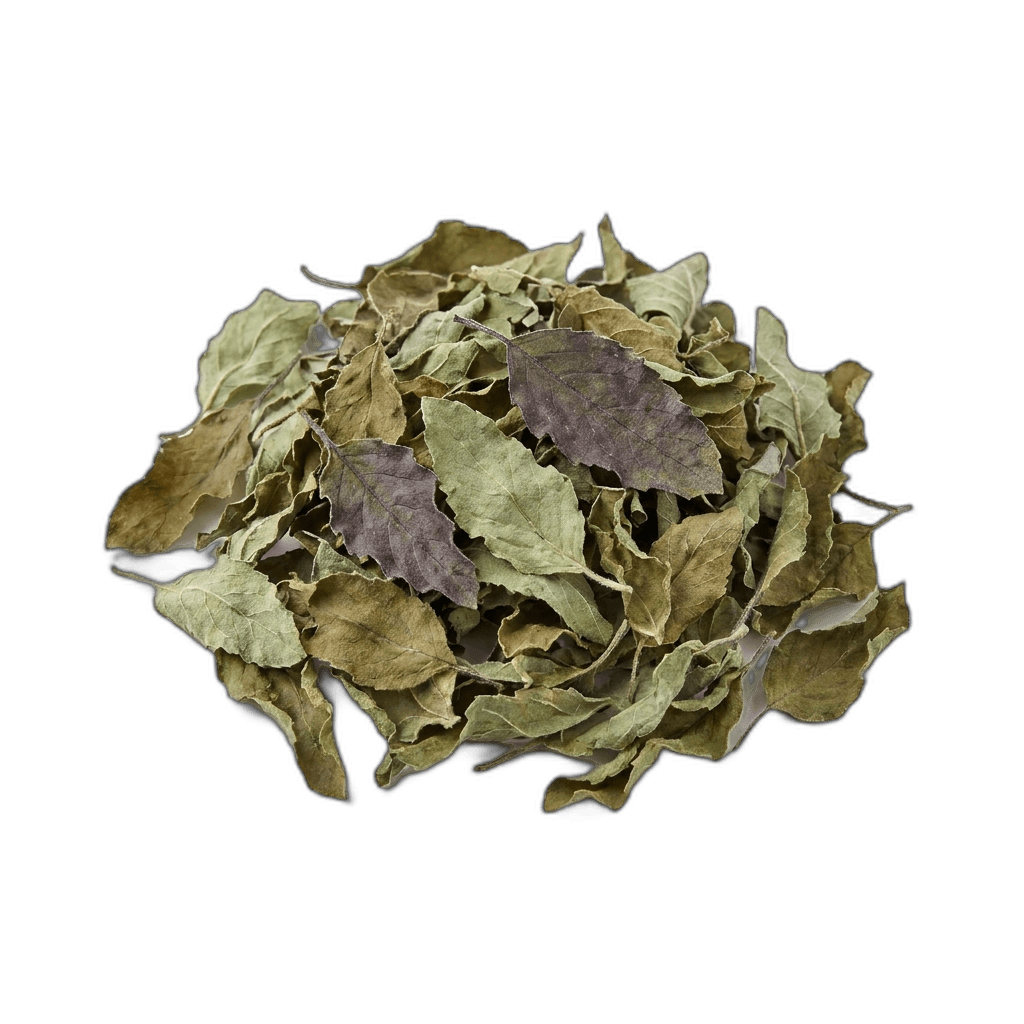
Odlad över Indiens centrala slätter och Himalayas utlöpare skördas tulsi som helt blad och skuggtorkas för att bevara sin varma, kryddnejlikeliknande arom. Infusionen är mjukt pepprig och örtig med en mild eugenolsötma, och tulsi har länge varit värderad inom Ayurveda som en adaptogen för vardaglig lugn. Brygg ensam för en koffeinfri kopp eller blanda med grönt te, ingefära eller citrongräs.
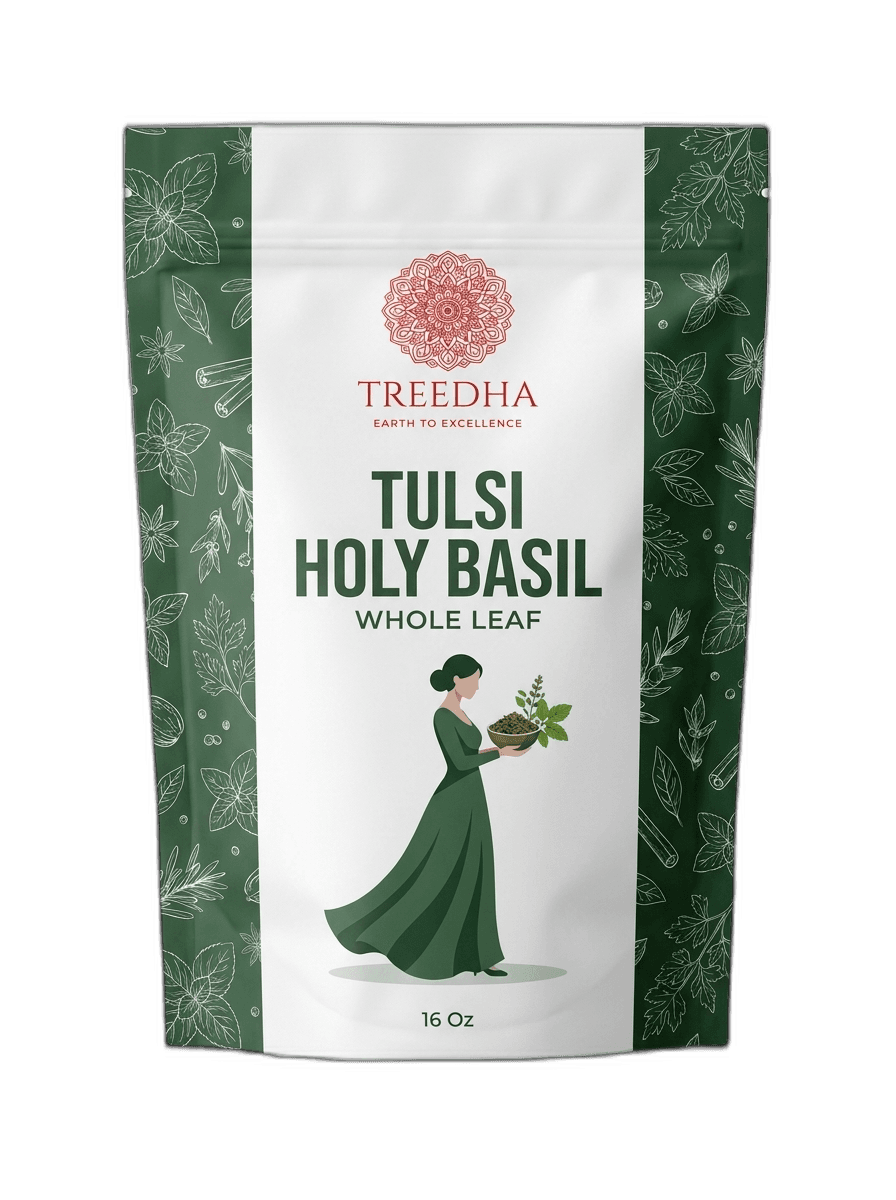
Förseglad på topp, levererad med ursprung.
Förpackad i återförslutningsbara påsar av livsmedelskvalitet som låser in arom och färg — var och en märkt med ursprung, kvalitet och smakprofil.
- Indien · centrala slätter och Himalayas utlöpare
- Helbladsörtkvalitet (Rama och Krishna)
- Handskördat · skuggtorkat löst blad
- Naturligt koffeinfritt
- Ångsteriliserad · ETO-fri · laboratorietestad
- 18-24 månader torkad, förseglad och torr
Även känd som · Holy Basil · Sacred Basil · Ocimum sanctum
Så använder du den
Koffeinfri infusion med en enda ört
Blandad med grönt te för en adaptogen kopp
Kombinerad med ingefära, citrongräs eller honung
Iste och örtteer för välmående
Varmt kvällstonikum
Tulsi Holy Basil Tea (Tulsi), also known as Ocimum sanctum or Sacred Basil, is a naturally caffeine-free herbal infusion renowned for its adaptogenic properties. Sourced from the Central Indian plains and Himalayan foothills, it is prized in the bulk trade for its distinctive aroma and traditional wellness applications.
Sourcing & Origin
Treedha's Tulsi Holy Basil Tea, known by its botanical name Ocimum sanctum, originates from the fertile Central Indian plains and the lower hill belts of the Himalayan foothills. These regions offer optimal climatic conditions for cultivating the Rama and Krishna varieties, known for their distinct phytochemical profiles.
Our whole-leaf herbal grade Holy Basil is hand-harvested, ensuring minimal damage to the delicate leaves. It is then carefully shade-dried to preserve its volatile oils and natural vibrant colour. This meticulous processing at the source is crucial for maintaining the herb's integrity and delivering consistent quality for bulk buyers.
Export Grades & Specifications
In the bulk trade, the quality of Tulsi Holy Basil Tea is defined by several key specifications. Treedha supplies whole-leaf herbal grade Ocimum sanctum, specifically the Rama and Krishna varieties. These grades are chosen for their higher volatile oil content and preferred leaf cut for herbal infusions.
We ensure our Tulsi Holy Basil leaves maintain optimal purity and moisture content, critical for extended shelf life and preventing degradation. The bright, balanced green colour signifies careful post-harvest handling and proper drying, a hallmark of premium export quality. Our specifications are designed to meet the rigorous demands of international importers seeking unadulterated herbal ingredients.
| Specification | Whole-leaf Herbal Grade (Rama & Krishna) |
|---|---|
| Form | Hand-harvested, shade-dried loose leaf |
| Purity | 100% pure herb, ETO-free, foreign matter < 1% |
| Volatile Oil | 0.7-1.2% (Rama ~45% eugenol; Krishna ~55% eugenol) |
| Moisture | Below 8% (typical for dried herbs) |
| Caffeine | Naturally caffeine-free |
Quality, Safety & Compliance
Treedha prioritises stringent quality and safety protocols for all bulk exports of Tulsi Holy Basil Tea. Our product is steam-sterilised and guaranteed ethylene-oxide (ETO)-free, aligning with the strict zero-tolerance policies or extremely low maximum residue levels (MRLs) observed in key import markets like the European Union.
All consignments undergo comprehensive lab testing to meet international regulatory limits. This includes screening for aflatoxins, heavy metals (such as lead below 2.0 mg/kg, cadmium below 0.3 mg/kg, and absence of mercury as per EU standards), and pesticide residues. For the EU, a default MRL of 0.01 mg/kg applies where no specific MRL is set. Microbiological safety, including the absence of pathogenic bacteria like Salmonella, is verified through thorough testing. Essential documentation, including Certificates of Analysis (COA) and Phytosanitary Certificates, accompanies every shipment, ensuring full compliance with destination country regulations.
Global Demand & Target Markets
The global demand for Tulsi Holy Basil Tea (Ocimum sanctum) is robust and expanding, primarily driven by growing consumer awareness of its adaptogenic and wellness properties. Importers and food brands are increasingly seeking natural, clean-label ingredients for functional beverages and health-focused food products. The rise of preventive healthcare and interest in traditional botanicals further fuels this market.
Key export destinations for Indian herbal teas, including Sacred Basil, include the United States, United Arab Emirates, United Kingdom, Germany, and Russia. Specifically for Ocimum sanctum under HS Code 12119094, Bangladesh and the United States are significant importers. The market's growth is also supported by the increasing accessibility through e-commerce and a broader consumer shift towards organic and specialty teas globally.
Logistics, HS Code & Packing
For bulk shipments of Tulsi Holy Basil Tea, the most appropriate Harmonised System (HS) code is generally 0902, specifically subheadings such as 09021090, classifying it as a prepared herbal tea. For raw dried leaves, HS code 12119094 (for Ocimum sanctum Tulsi) is also relevant. Our team ensures accurate classification to facilitate smooth international customs clearance.
Treedha offers flexible bulk packing formats to suit diverse importer requirements, typically in multi-ply Kraft paper bags or food-grade HDPE bags, ranging from 5 kg to 25 kg. Our minimum order quantity (MOQ) is designed to accommodate wholesale and private-label buyers, reflecting efficient container utilisation. We manage logistics under standard Incoterms, providing clear lead times and shipping schedules. Our dried, sealed Holy Basil Tea maintains a shelf life of 18-24 months when stored correctly in cool, dry conditions, ensuring product freshness upon arrival.
- globallinker.com — globallinker.com
- indiamart.com — indiamart.com
- zauba.com — zauba.com
- volza.com — volza.com
- cybex.in — cybex.in
- oec.world — oec.world
Frågor
- Är tulsi samma sak som helig basilika?
- Ja. Tulsi är det indiska namnet på helig basilika (Ocimum sanctum). Den är botaniskt skild från den söta basilika som används i italiensk matlagning och odlas specifikt som en helig och medicinsk ört.
- Varför kallas tulsi en adaptogen?
- I ayurvedisk tradition värderas tulsi för att hjälpa kroppen hantera vardaglig fysisk och mental stress, vilket placerar den bland de örter som vanligen beskrivs som adaptogener. Vi levererar den som blad och te snarare än ett koncentrerat extrakt.
- Innehåller tulsite koffein?
- Nej. Tulsi är ett örtblad utan naturligt koffein, vilket gör det lämpligt när som helst på dygnet, inklusive kvällen.
- What varieties of Tulsi Holy Basil Tea does Treedha supply?
- Treedha supplies whole-leaf herbal grade Tulsi Holy Basil Tea from the Rama and Krishna varieties of *Ocimum sanctum*, sourced from specific regions in India.
- How is Treedha's Tulsi Holy Basil Tea processed to ensure quality?
- Our Tulsi Holy Basil Tea is hand-harvested, shade-dried, and then sieved to ensure optimal leaf integrity and volatile oil retention. It is also steam-sterilised and lab-tested to meet international purity standards.
- What certifications and safety assurances does Treedha provide for bulk Tulsi exports?
- Treedha's Tulsi Holy Basil Tea is ETO-free and lab-tested for MRLs (pesticides), aflatoxins, heavy metals (e.g., lead, cadmium), and microbial safety (e.g., *Salmonella*) to comply with EU and US regulations. We provide Certificates of Analysis and Phytosanitary Certificates.
- What is the typical shelf life of Treedha's bulk Tulsi Holy Basil Tea?
- When stored in a cool, dry, and sealed environment, our dried, whole-leaf Tulsi Holy Basil Tea has a typical shelf life of 18-24 months, ensuring long-term quality for importers.
- What are the primary applications for imported Holy Basil (Ocimum sanctum) tea?
- Bulk Holy Basil (Sacred Basil) is primarily used by herbal tea brands, functional beverage manufacturers, and nutraceutical companies seeking adaptogenic ingredients for infusions, blends, and health-focused products due to its recognised wellness properties.
- What HS Code is used for exporting Tulsi Holy Basil Tea from India?
- For prepared herbal teas like Tulsi Holy Basil Tea, the commonly used HS Code is 0902, with specific subheadings such as 09021090. For raw dried leaves, 12119094 may apply.