Emmer Wheat Farro
Khapli Gehu
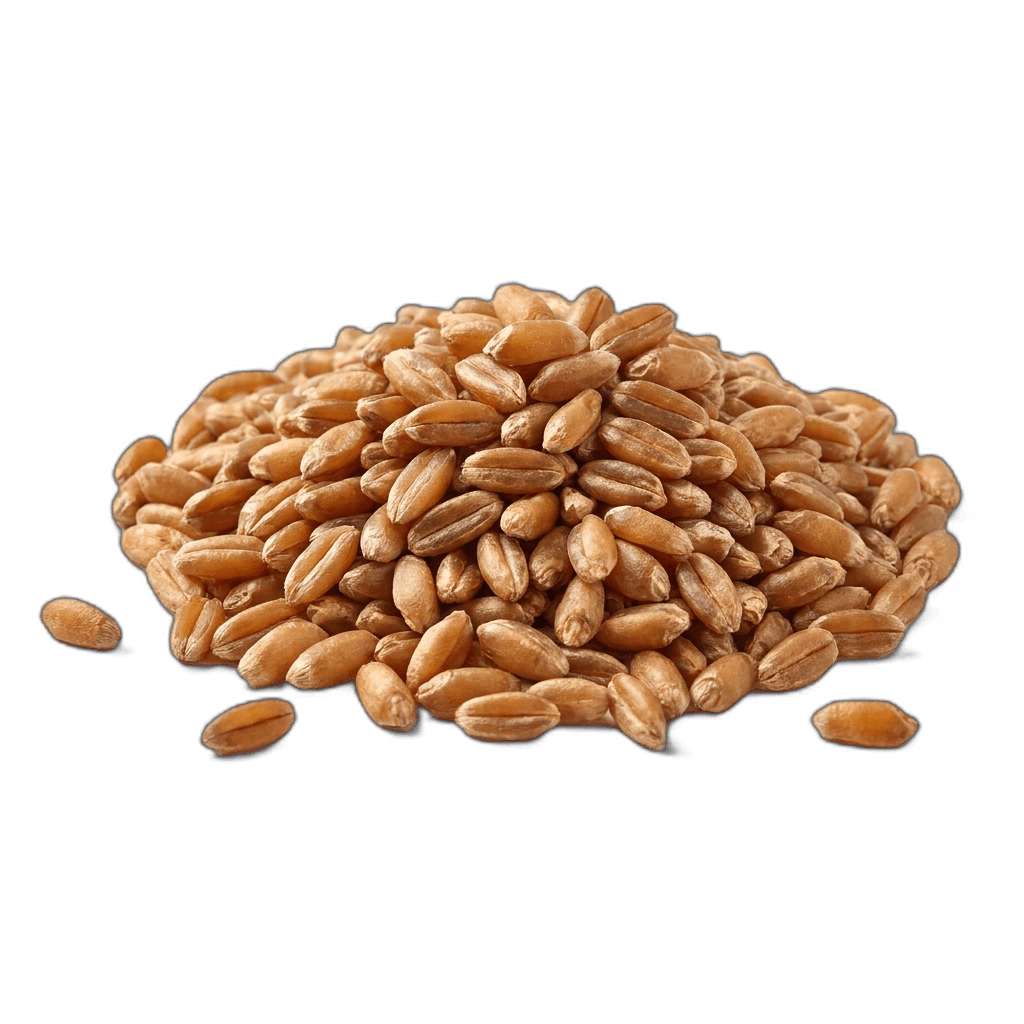
Conhecido como khapli no sul do Maharashtra e no norte do Karnataka, este trigo antigo descascado tem sido cultivado em sequeiro no Decão há milénios e antecede o trigo-pão moderno. Os grãos âmbar e roliços cozem até obter uma mastigabilidade satisfatória, com um sabor profundo de noz torrada e uma carga glicémica inferior à do trigo comum. Coza-o como base de salada de grãos, incorpore-o em sopas ou moa-o em pedra para obter um atta rústico e rico em minerais.
Selado no auge, expedido com proveniência.
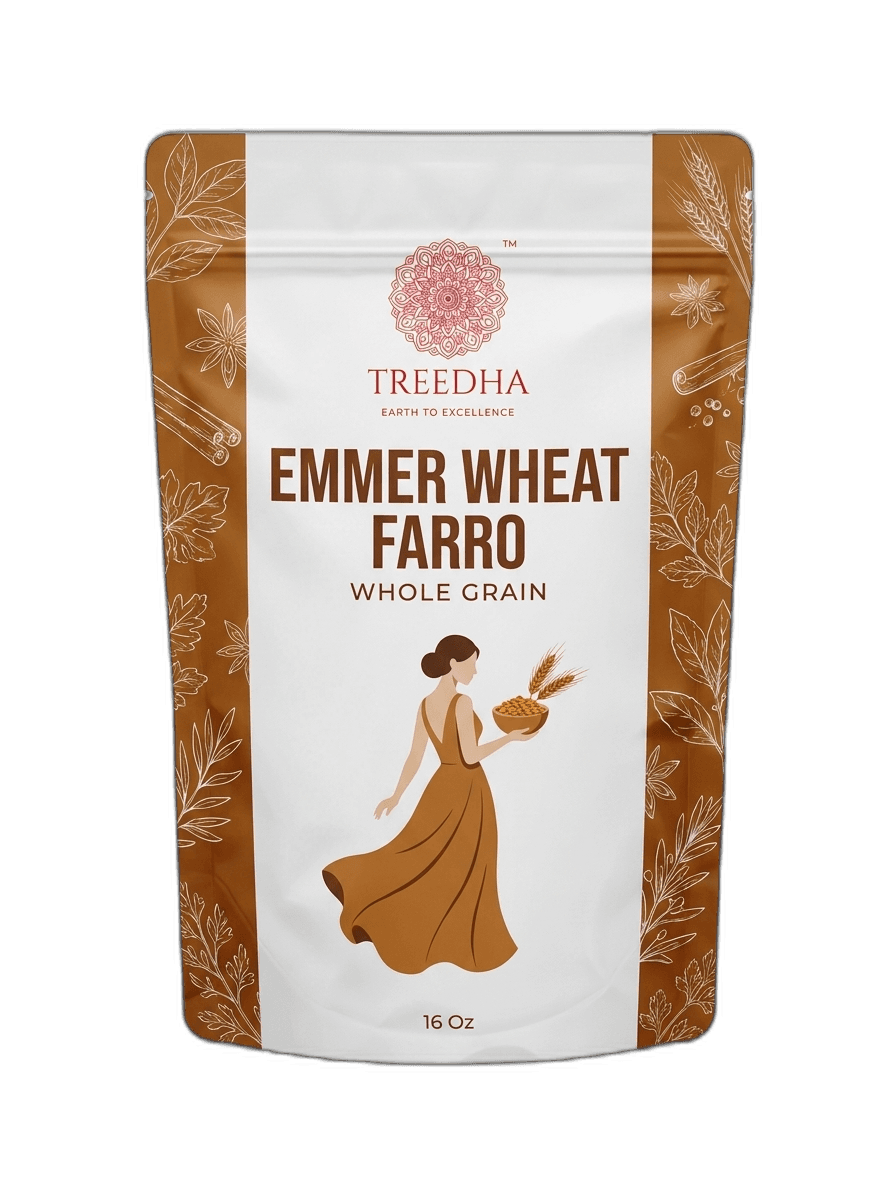
Embalado em saquetas reutilizáveis, de qualidade alimentar, que preservam o aroma e a cor — cada uma identificada com a sua origem, grau e perfil de sabor.
- Decão, Índia (Maharashtra e Karnataka)
- Grão inteiro de emmer descascado
- Grão inteiro limpo
- Baixo, aprox. 40-55
- Grão único, sem mistura; contém glúten/trigo
- 12-18 meses, à temperatura ambiente
Também conhecido como · Farro · Emmer · Khapli wheat · Triticum dicoccum
Como utilizar
Cozido como base mastigável de salada de grãos ou pilaf
Adição substancial a sopas, guisados e minestrone
Moído em pedra em khapli atta para rotis e pães
Papa de pequeno-almoço com leite e jagra
Tigelas frias de grãos com ervas e azeite
Emmer Wheat Farro (Khapli Gehu) is a heritage ancient grain, specifically *Triticum dicoccum*, valued for its nutritional profile and distinctive nutty flavour. Our whole hulled kernels, originating from the Deccan plateau in India, are supplied to global importers and food brands seeking authentic, high-quality ancient grains.
Sourcing & Origin
Treedha's Emmer Wheat Farro, known locally as Khapli Gehu, is sourced directly from the rain-fed farms of Southern Maharashtra and Northern Karnataka in India. This Deccan plateau region, nestled at altitudes between 500-700 metres, provides ideal conditions for cultivating this heritage emmer landrace.
The unique agro-climatic profile of these origins contributes to the grain's distinct nutty flavour and robust texture. For bulk buyers, sourcing from this specific Indian origin ensures authenticity and access to a traditionally cultivated, non-hybridised variety, highly sought after in global markets.
Export Grades & Specifications
Our Emmer Wheat Farro (Khapli Gehu) is supplied as a whole hulled kernel, preserving its germ and bran. Key specifications are meticulously maintained to meet international trade standards.
Purity is paramount, ensuring a single-grain product free from admixture, foreign matter, and pest infestation. Moisture content is strictly controlled below 12-13% to guarantee optimal shelf life and prevent spoilage during transit and storage. Protein levels typically range from 13.07% to 18%, reflecting the grain's nutritional density. We also ensure a uniform golden colour, indicative of quality.
| Specification | Detail |
|---|---|
| Origin | Deccan, India (Maharashtra & Karnataka) |
| Grade | Whole hulled emmer kernel, heritage landrace |
| Form | Cleaned whole grain |
| Moisture Content | Max 12-13% |
| Purity | Single-grain, no admixture, free from foreign matter |
| Protein Content | 13.07% - 18% |
| Glycaemic Index | Low (approx. 40-55) |
| Contains | Gluten/Wheat |
| Shelf Life | 12-18 months, ambient |
| Colour | Uniform golden |
Quality, Safety & Compliance
Treedha prioritises stringent food safety and compliance with international regulations, including those of the EU and US. Our Emmer Wheat Farro (Khapli Gehu) undergoes steam sterilisation and is guaranteed Ethylene Oxide (ETO)-free, aligning with the EU's strict ban on ETO in food products, where MRLs are typically 0.02-0.1 mg/kg. While US regulations on ETO differ, our commitment to ETO-free processing ensures broader market access.
Each batch is lab-tested to meet specific maximum residue limits (MRLs) for pesticides, heavy metals (Lead, Cadmium, Arsenic, Mercury), and mycotoxins like aflatoxins. EU limits for cadmium in cereals are 0.20 mg/kg, and for lead, 0.2 mg/kg. We confirm the complete absence of Salmonella, a critical microbiological safety requirement for grains and pulses in both the EU and US. Furthermore, Sudan dyes (I, II, III, IV) are strictly prohibited and tested for. Comprehensive Certificates of Analysis (COA) and phytosanitary certificates are provided for every shipment, ensuring full traceability and compliance.
Global Demand & Target Markets
The global demand for Emmer Wheat Farro (Triticum dicoccum) is driven by a pronounced shift towards healthier, nutrient-dense whole grains and plant-based diets. Consumers increasingly seek ancient grains for their high fibre, protein, and mineral content. Farro's distinctive nutty flavour and chewy texture also contribute to its growing culinary appeal across various cuisines.
Europe, particularly Italy, Germany, Austria, and Switzerland, represents a significant market, with Italy having a strong historical tradition of farro consumption. The United States is experiencing robust growth, propelled by clean-label food trends. South Korea has also emerged as a notable importer of Emmer wheat. These regions present strong opportunities for importers and distributors seeking to capitalise on the ancient grains revival.
Logistics, HS Code & Packing
For global trade, whole hulled Emmer Wheat Farro (Khapli Gehu) is classified under HS Code 1104.29 for 'Cereal grains otherwise worked'. Specifically, Indian exports align with HSN Code 11042900 for 'Other Hulled Cereals (Non-Packaged)'.
Treedha offers flexible bulk packing solutions to suit importer requirements, typically in formats suitable for wholesale distribution, from multi-kilogram sacks to larger bulk options. Our minimum order quantity (MOQ) is structured to facilitate efficient bulk shipments, with details available upon enquiry. We handle various Incoterms, providing clear frameworks for international delivery. The product maintains a shelf life of 12-18 months under ambient storage conditions, ensuring longevity for our trade partners.
- avoiceforchoiceadvocacy.org — avoiceforchoiceadvocacy.org
- americanprogress.org — americanprogress.org
- zauba.com — zauba.com
- busy.in — busy.in
- nih.gov — nih.gov
- food-safety.com — food-safety.com
Questões
- O khapli gehu é o mesmo que o farro?
- Sim. Khapli é o nome indiano do trigo emmer (Triticum dicoccum), o mesmo grão vendido em Itália e por todo o Ocidente como farro. O khapli indiano é a mesma espécie tradicional, com a sua própria tradição de cultivo no Decão.
- O trigo emmer é sem glúten?
- Não. O emmer é um trigo antigo e contém glúten, pelo que não é adequado para celíacos. Tem, no entanto, uma estrutura de glúten diferente e um índice glicémico inferior ao do trigo-pão moderno.
- Como coze-se o grão inteiro?
- Enxague e depois coza em bastante água durante 30-40 minutos, até ficar tenro mas ainda mastigável, tal como um arroz para risoto ou cevada perlada. Demolhar de um dia para o outro encurta a cozedura e amacia a mordida.
- What is Emmer Wheat Farro (Khapli Gehu)?
- Emmer Wheat Farro, or Khapli Gehu, is an ancient, heritage variety of wheat (*Triticum dicoccum*) known for its whole hulled kernels, distinctive nutty flavour, and high nutritional value, including fibre and protein.
- Where does Treedha's Emmer Wheat Farro originate?
- Our Emmer Wheat Farro (Khapli Gehu) is sourced from the traditional rain-fed farming regions of Southern Maharashtra and Northern Karnataka on the Deccan plateau in India, ensuring authentic heritage landrace quality.
- Is your Emmer Wheat Farro compliant with EU and US import regulations?
- Yes, our Emmer Wheat Farro is steam-sterilised, ETO-free, and lab-tested to meet stringent EU and US MRLs for pesticides, heavy metals, mycotoxins (e.g., aflatoxins), and microbiological contaminants like Salmonella. We provide a full Certificate of Analysis (COA) with every shipment.
- What are the common HS Codes for bulk Emmer Wheat Farro?
- Globally, the common HS Code for whole hulled Emmer Wheat Farro is 1104.29. For Indian exports, the HSN Code 11042900 for 'Other Hulled Cereals (Non-Packaged)' is applicable.
- What are the typical packaging options for bulk orders?
- Treedha offers a range of bulk packaging solutions tailored for importers and distributors, including multi-kilogram bags and larger bulk sacks. Specific options can be discussed to meet your operational needs.
- What is the shelf life of your Emmer Wheat Farro?
- Our Emmer Wheat Farro has a typical shelf life of 12-18 months when stored under appropriate ambient conditions, ensuring suitability for long-distance shipping and storage.