Tapioca Pearls
Sabudana
Pérolas de amido brilhantes enroladas a partir de mandioca cultivada no sul da Índia e refinadas no cinturão do sagu em torno de Salem e Namakkal, o coração do comércio de tapioca do país. Cozidas a vapor para fixar a forma e secas ao sol até endurecer, ficam translúcidas e agradavelmente mastigáveis após a cozedura. Indispensáveis para o sabudana khichdi e os pratos de jejum, para os pudins de leite e para a boba do bubble tea que conquistou as ementas dos cafés em todo o mundo.

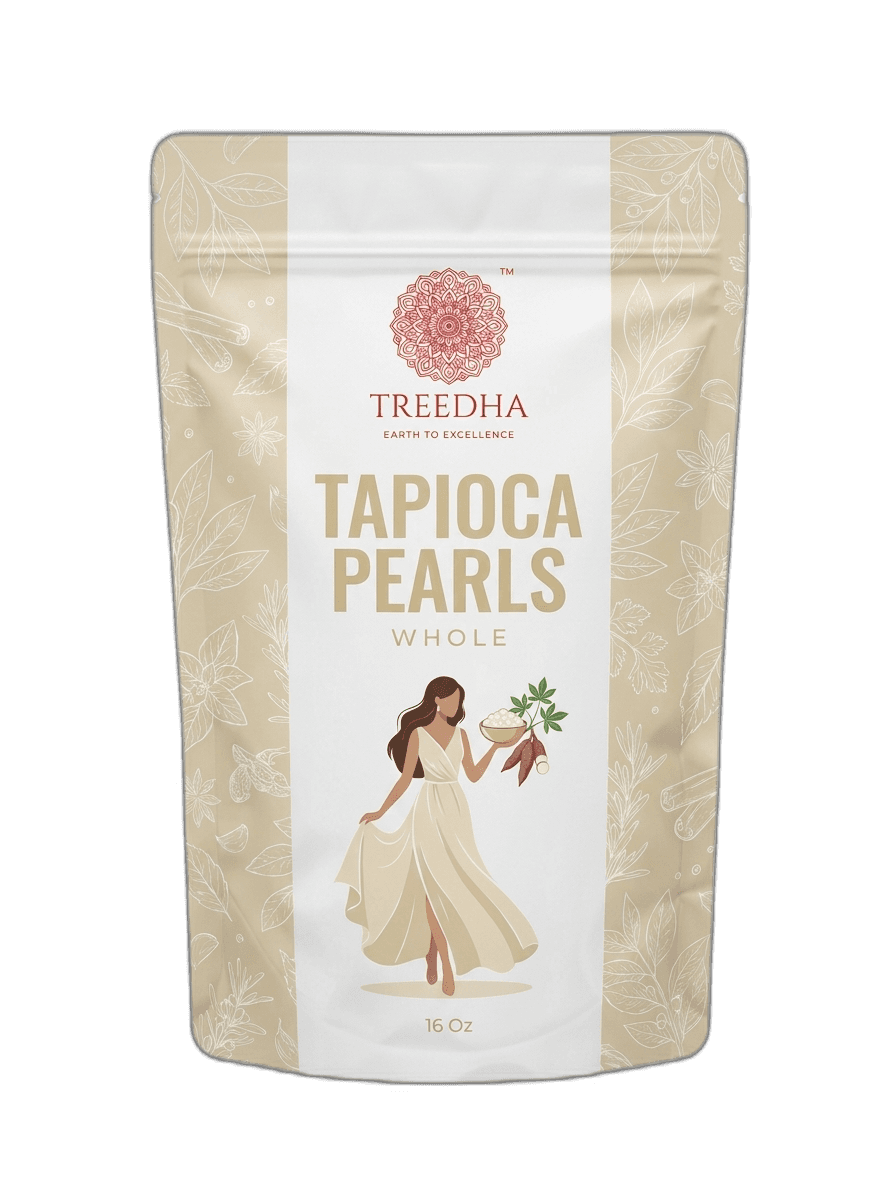
Selado no auge, expedido com proveniência.
Embalado em saquetas reutilizáveis, de qualidade alimentar, que preservam o aroma e a cor — cada uma identificada com a sua origem, grau e perfil de sabor.
- Tamil Nadu, Índia
- Sagu de tapioca de qualidade alimentar
- Pérolas de amido cozidas a vapor e secas
- Amido de mandioca (tapioca)
- Sem glúten, testada em laboratório
- 18+ meses, fechada à temperatura ambiente
Também conhecido como · Sago Pearls · Boba · Perles du Japon · Cassava Pearls
Como utilizar
Sabudana khichdi e pratos de jejum vrat
Pérolas de boba para bubble tea
Pudim de tapioca e sagu (kheer)
Espessar sopas, molhos e recheios
Sabudana vada estaladiço e fritos
Tapioca Pearls (Sabudana) are versatile starch pearls, derived from cassava, widely used in beverages like bubble tea, desserts, and gluten-free applications. Treedha offers food-grade, uniform medium pearls, sourced from India's prime growing regions, meeting stringent international food safety standards for bulk export.
Sourcing & Origin
Treedha's Tapioca Pearls, known also as Sabudana, Sago Pearls, or Cassava Pearls, originate from the Salem-Namakkal sago belt in Tamil Nadu, India. This region is renowned for its optimal cassava cultivation, providing the ideal starch base for pearl production.
The distinct agro-climatic conditions of Tamil Nadu ensure a consistent quality of cassava, which directly influences the final texture and stability of the pearls. Sourcing from this established origin guarantees the consistent 'QQ' chewiness highly valued by global buyers, especially within the burgeoning bubble tea industry. Our commitment to direct origin sourcing provides full provenance for every bulk shipment.
Export Grades & Specifications
Treedha offers food-grade tapioca sago in a uniform medium pearl size, crafted by extracting cassava starch, rolling it into pearls, then steaming and sun-drying. Achieving the desired 'QQ' texture, a balance of softness and resilience, is paramount for commercial applications like bubble tea, ensuring consistent product performance.
Our specifications are designed to meet diverse importer requirements, with meticulous attention to detail from raw material to finished product. We ensure purity and consistency, vital for both traditional culinary uses and modern beverage formulations. Buyers can expect full transparency through comprehensive Certificates of Analysis (COAs).
Quality, Safety & Compliance
Compliance with international food safety regulations is a cornerstone of Treedha's export operations for Tapioca Pearls (Sabudana). Our products are strictly ethylene-oxide (ETO) free, a critical requirement for market access in the EU and US, where ETO residues lead to product interception.
We adhere to stringent maximum residue limits (MRLs) for contaminants. For aflatoxins, our products comply with EU standards (e.g., 2 µg/kg for Aflatoxin B1 and 4 µg/kg for sum of aflatoxins), and US guidelines (20 µg/kg for total aflatoxins). All shipments are tested for heavy metals, Sudan dyes, and other microbiological contaminants like Salmonella, ensuring they meet global food safety benchmarks. Comprehensive Certificates of Analysis (COA) are provided with every batch, verifying technical specifications such as starch content, moisture, and absence of bleaching agents, alongside necessary phytosanitary certificates and FDA registration for the US market.
Global Demand & Target Markets
The global demand for Tapioca Pearls (Sabudana, Boba) is significantly driven by the widespread popularity of bubble tea beverages, particularly across North America, Europe, and the Asia-Pacific region. The United States consistently ranks as a top importer, accounting for a substantial share of global imports under HS 19030000. Other key importing nations include China, Canada, the United Kingdom, and South Korea, with emerging markets in Nepal, Singapore, Australia, Ghana, Tanzania, and the UAE also showing interest.
Beyond bubble tea, demand is further bolstered by the increasing consumer preference for gluten-free and plant-based food ingredients. This trend, coupled with innovation in culinary applications such as desserts and bakery products, continues to expand the market for these versatile pearls. The growth of at-home beverage crafting and the global expansion of bubble tea chains underscore the need for a reliable, high-quality bulk supply.
Logistics, HS Code & Packing
The primary Harmonized System (HS) code for Tapioca Pearls (Sabudana) in international trade is 19030000, covering prepared tapioca and its substitutes in various forms. For "sago sabudana" from India, another relevant code is 11081910, though 19030000 is more broadly applied to finished pearls.
Treedha offers flexible bulk packing options tailored to importer needs, including 500g and 1kg sizes, all designed for optimal preservation and an 18+ month ambient shelf life when sealed. Our minimum order quantity (MOQ) approach focuses on meeting specific buyer requirements, ranging from smaller pallet quantities to full container loads (FCL) for large-scale distributors. We operate on standard Incoterms to facilitate smooth international trade, ensuring efficient delivery to major global ports.
- futuremarketinsights.com — futuremarketinsights.com
- zauba.com — zauba.com
- trendeconomy.com — trendeconomy.com
- tridge.com — tridge.com
- volza.com — volza.com
- skyminder.com — skyminder.com
Questões
- O sabudana é o mesmo que pérolas de tapioca?
- Sim. Sabudana é o nome indiano das pérolas de tapioca ou sagu — as mesmas pérolas de amido de mandioca usadas em boba, pudins e pratos de jejum.
- Posso fazer boba com estas?
- Sim. Ferva as pérolas até ficarem translúcidas e tenras, depois deixe-as em infusão em calda de açúcar; resultam na clássica boba mastigável de bubble tea, bem como em pratos indianos de sabudana.
- As pérolas de tapioca são sem glúten?
- Sim. São amido de mandioca puro, sem qualquer teor de trigo ou cereais, o que as torna naturalmente sem glúten.
- What is the primary origin of Treedha's Tapioca Pearls?
- Treedha's Tapioca Pearls (Sabudana, Sago Pearls) are sourced from the Salem-Namakkal sago belt in Tamil Nadu, India, a region known for its high-quality cassava cultivation.
- What are the common Western trade names for Tapioca Pearls?
- These pearls are widely known by Western trade names such as Sago Pearls, Boba, Perles du Japon, and Cassava Pearls, in addition to Sabudana.
- Are Treedha's Tapioca Pearls free from Ethylene Oxide (ETO) and major contaminants?
- Yes, our Tapioca Pearls are guaranteed ETO-free and rigorously tested to comply with stringent EU and US import limits for contaminants like aflatoxins, heavy metals, and Sudan dyes.
- What is the typical shelf life and how should they be stored?
- Our Tapioca Pearls have an excellent shelf life of 18+ months when stored in ambient conditions in sealed, original packaging, maintaining their quality and texture.
- What is the HS code for bulk Tapioca Pearls?
- The primary Harmonized System (HS) code for Tapioca Pearls in international trade is 19030000, which covers prepared tapioca products.
- Can Treedha provide a Certificate of Analysis (COA) for each batch?
- Yes, Treedha provides a comprehensive Certificate of Analysis (COA) for every batch, detailing all key specifications and confirming compliance with food safety standards.